Massachusetts & New Hampshire · Homeowner education
Your Assessment Went Up
A higher property assessment can make a homeowner wonder how much the next tax bill will rise. The assessment matters, but it is only part of the calculation. The tax rate, the amount the community needs to raise and any applicable tax relief also affect what you owe.
For buyers and sellers across the Merrimack Valley, it helps to understand both numbers before treating an assessment notice—or a tax figure in a listing—as the full picture.
Why Lowell is a useful example right now
Lowell completed its FY2027 public disclosure period September 14–18, 2026. Its Assessors’ page reports overall residential assessment changes from FY2026 of 3.86% for single-family homes and 4.05% for condos. Individual properties may change by different amounts.
Those assessments reflect values as of January 1, 2026, based on qualified 2025 market activity. As checked October 8, the city’s page says the assessments were submitted for final state certification and approval. The rates displayed are still labeled FY2026. They should not be treated as confirmed FY2027 rates.
The calculation behind the bill
A simplified annual base tax calculation is: assessed value divided by 1,000, multiplied by the applicable tax rate. Exemptions, credits and other charges can change the final amount.
The tax levy is the total amount raised through property taxes. Assessments help distribute that amount among properties. If the tax base grows, the rate may fall; budget changes and shifts in relative property values can still change an individual bill. A revaluation alone does not tell you how much your taxes will change.
Source: Massachusetts DLS explanation of levies and assessed values
Here is a hypothetical example. A home assessed at $500,000, taxed at $12 per $1,000, has a $6,000 annual base tax. If its assessment rises 10% to $550,000 and the new rate is $11, the base tax becomes $6,050—about 0.8% higher. A different rate produces a different result.
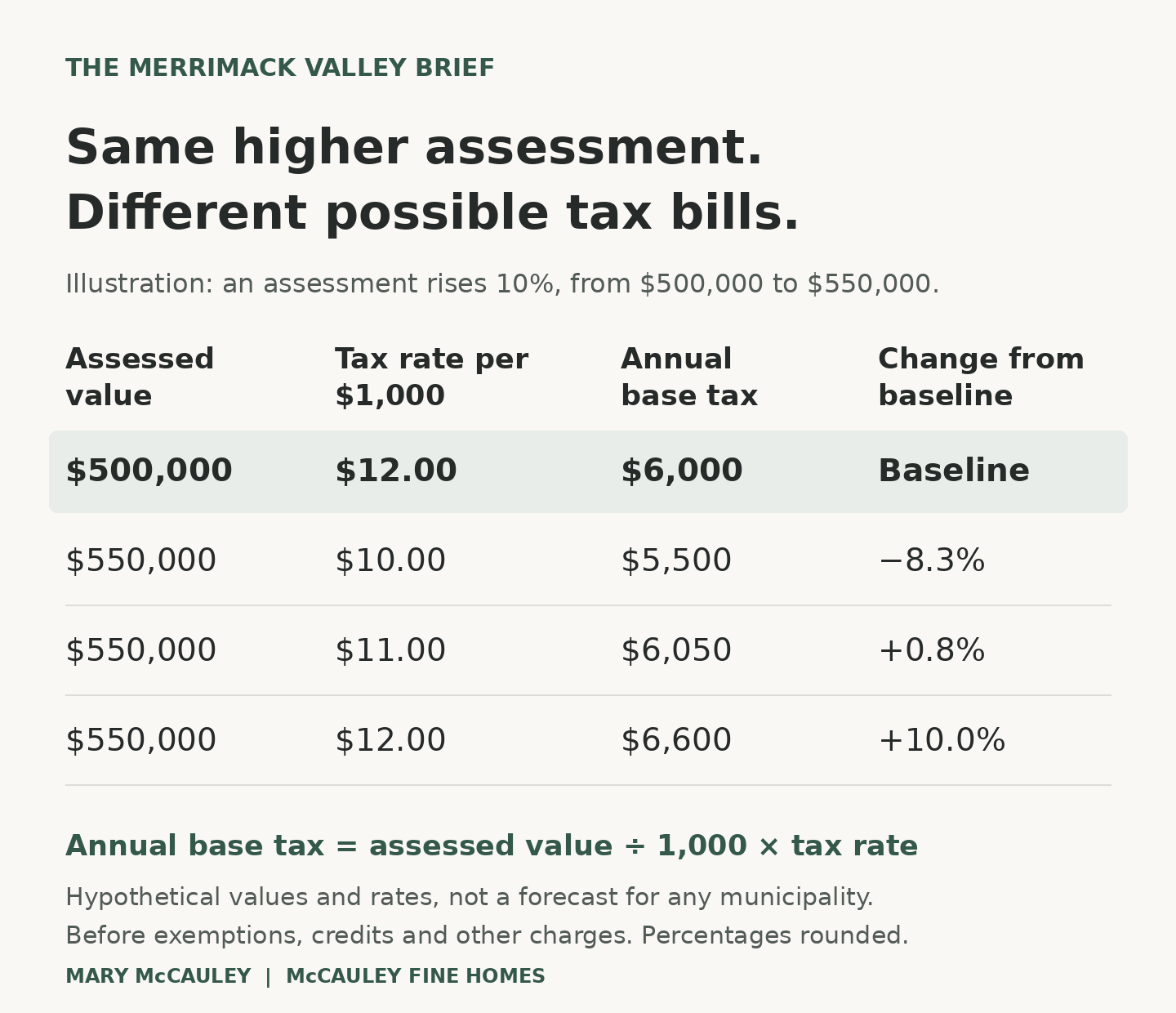
Illustrative only. These values and rates are hypothetical, not Lowell figures or a forecast for any municipality. Annual base taxes exclude exemptions, credits and other charges.
Massachusetts and New Hampshire use different calendars
In Massachusetts, Proposition 2½ limits municipal property-tax revenue under its rules. It does not cap each homeowner’s annual tax-bill increase at 2.5%. Property values, classification decisions and other factors can change your share of the levy.
Source: Massachusetts Proposition 2½ resources
Source: Municipal explanation of the individual-bill distinction
For an ordinary Massachusetts assessment abatement, the filing deadline is generally the due date of the first installment of the actual tax bill, after the rate is established. A preliminary bill is different. Confirm the deadline printed on your bill and the assessor’s instructions rather than assuming one date applies to every town.
Source: Massachusetts General Laws Chapter 59, Section 59
In New Hampshire, the ordinary application deadline is March 1 following the “notice of tax” under RSA 76:16. Under RSA 76:1-a, that ordinarily refers to the final tax bill’s mailing date. For a final notice of tax issued in 2026, the ordinary deadline is March 1, 2027. Check your municipality’s current form and instructions. An informal discussion about the value does not replace a timely written application.
Sources: New Hampshire RSA 76:16 and RSA 76:1-a
New Hampshire homeowners should also avoid multiplying a new assessment by an old tax rate. Concord’s current revaluation guidance makes that point explicitly and says a 2026 abatement may be filed after the final 2026 bill, no later than March 1, 2027. Nashua likewise says municipal abatement applications are accepted after the December final bill and are due by the following March 1. Revaluation schedules and final rates must still be checked locally, including in Hudson, Merrimack and surrounding towns.
Sources: Concord revaluation FAQs and Nashua deadlines
What to check before you challenge a value
Review your property record. Check living area, lot size, bathrooms, finished basement space, condition and recorded improvements. Ask the assessor how to report an error.
Check the valuation date and comparable sales used. A current online estimate or today’s asking price may not address the relevant assessment date.
Read the bill itself. Confirm the tax year, applicable rate, taxable value, any exemptions or credits and payment deadlines.
Gather evidence and file on time. Explain the specific error or valuation concern, and follow the official abatement process. Continue to follow payment requirements while the application is reviewed.
What this means when buying or selling
An assessment is a value for tax purposes as of a particular date. A listing price is an asking price, and a lender’s appraisal serves a separate financing purpose. They can differ.
When budgeting for a purchase, verify the tax figure with municipal records and ask whether it reflects a preliminary bill, an older rate or relief available to the current owner. Confirm which exemptions or credits you would qualify for yourself. If taxes are escrowed, ask the lender how a change could affect the total monthly payment.
Mary’s Take
I want homeowners to look beyond the percentage on the assessment notice. A higher value deserves a closer look, but the useful questions are whether the property record is accurate, which tax year the figures belong to and what rate will actually apply.
For buyers, the same care belongs in the budget. Before relying on a tax number in a listing, verify it and understand what could change. A few questions early can help you plan with more confidence.
A question for you
Have you received an assessment notice or tax bill that surprised you? What was hardest to understand—the value, the rate or the deadline? Reply and tell me.
If you are buying or selling in the Merrimack Valley, I can help you review the property information and identify questions to bring to the assessor or your lender.
Mary McCauley, REALTOR® | McCauley Fine Homes | Keller Williams Realty Merrimack Valley | Licensed in Massachusetts and New Hampshire
This article is for general educational purposes and is not tax, legal or appraisal advice. Examples are hypothetical and rounded. Rules, rates and deadlines can change. Confirm information with your municipal assessor or tax collector and consult a qualified professional about your circumstances.