
Massachusetts & New Hampshire · Buyer & seller education
Mortgage Rates Reached 7.28%. Should a Seller Cut the Price or Offer a Credit?
When mortgage rates rise, buyers understandably focus on the monthly payment. Sellers facing a slower response may reach for a price reduction. But a lower price is only one way to make a purchase work. Depending on what is holding the buyer back, a credit toward closing costs or discount points may be more useful.
Freddie Mac’s national survey put the average 30-year fixed mortgage rate at 7.28% on October 1, 2026, up from 7.03% on September 24. These are national weekly averages, not a rate any particular buyer has been offered. The buyer’s credit, loan program, down payment, property and timing will affect an actual quote. Source: Freddie Mac Primary Mortgage Market Survey
One home, three possible approaches
Imagine a $500,000 home and a buyer putting 20% down. At an illustrative 7.28% fixed rate over 30 years, the $400,000 loan has a principal-and-interest payment of about $2,737 per month. This example excludes property taxes, insurance, HOA dues, closing costs and other possible loan charges.
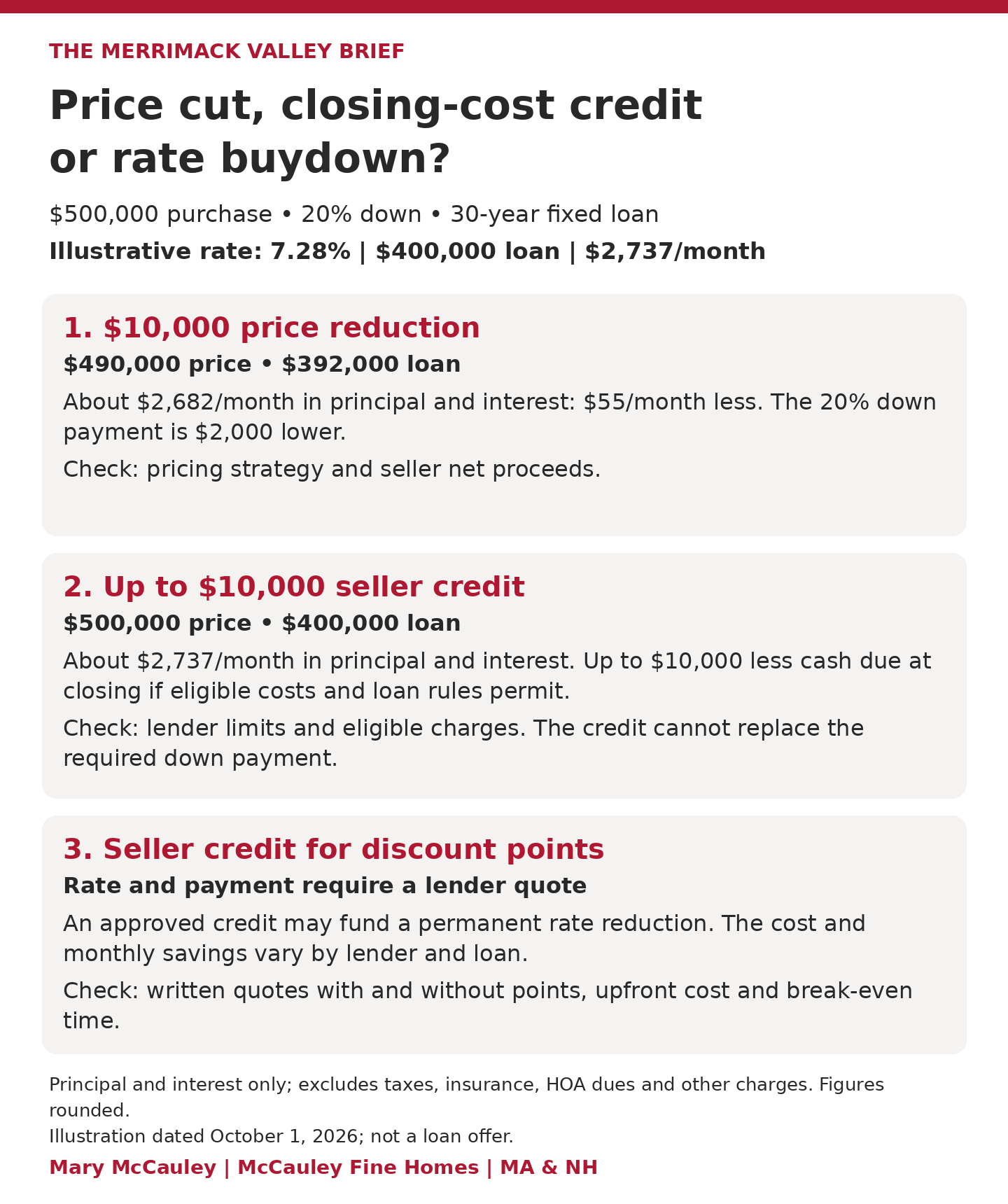
The comparison shows why the buyer’s actual obstacle matters. A $10,000 price reduction in this example lowers principal and interest to about $2,682 a month, saving about $55 a month, and reduces a 20% down payment by $2,000. A seller credit may preserve the original price while reducing the buyer’s eligible cash due at closing. A credit used for discount points may reduce the monthly payment, but only a current lender quote can show the cost, rate and savings.
These are alternatives for comparison, not a promise that every buyer can use a $10,000 credit. A lender must confirm the loan rules, available costs and final figures. Under Fannie Mae’s conventional-loan rules, interested-party contributions cannot be used for a borrower’s down payment or required reserves, and contribution limits apply. Source: Fannie Mae Selling Guide
The difference between seller credits, points and lender credits
A seller credit is negotiated in the purchase agreement and pays qualifying transaction costs, subject to the lender and loan program.
A discount point is an upfront loan charge paid to the lender to obtain a lower interest rate. One point equals 1% of the loan amount: on a $400,000 loan, one point costs $4,000. How much that point lowers the rate depends on the lender and market.
A lender credit goes in the other direction: the lender offsets closing costs in exchange for a higher rate. Sources: CFPB on seller credits and CFPB on points and lender credits
There is also a temporary buydown, which reduces payments for an initial period while the loan’s permanent payment terms remain in place. A buyer should be comfortable with the payment after that period ends. Source: Fannie Mae temporary buydown guidance
How buyers can decide
Ask the lender for side-by-side written figures using the same loan type, down-payment percentage and closing date. Keep the purchase price the same for the first three scenarios, then compare a lower-price alternative:
- The loan with no points or credits.
- A seller credit applied to qualifying closing costs.
- A permanent rate buydown using the same proposed seller contribution, if available.
- A lower purchase price with no seller credit.
Compare cash to close, the full monthly payment, the interest rate and APR, upfront lender charges, and total borrowing cost over the period you expect to keep the loan.
If points cost $4,000 and save $50 a month, a simple break-even estimate is 80 months. That estimate ignores the time value of money and any change in loan payoff; refinancing or selling earlier can change the result. The Consumer Financial Protection Bureau explains where to find these numbers on the Loan Estimate, including its five-year comparison. Source: CFPB Loan Estimate comparison guide
What sellers should consider
Before announcing a blanket price cut or credit, ask what is actually stopping qualified buyers. Is the monthly payment outside their budget? Is the immediate obstacle cash to close? Has the home simply been priced above comparable sales? The answer should shape the offer strategy, while the seller compares net proceeds under each scenario.
In both Massachusetts and New Hampshire, the same arithmetic applies, but property taxes, insurance, HOA costs and loan program rules can make the total payment look quite different from one property to the next. A well-structured concession must also be workable for the buyer’s lender and reflected clearly in the offer and closing figures.
Mary’s Take
The part that surprises many people is how little a modest price reduction can change the monthly payment. That does not mean a price reduction is the wrong choice; a home still has to be positioned correctly for its market. But when the obstacle is cash to close or the monthly payment, I want the buyer, seller and lender comparing real figures before anyone assumes that cutting the price is the most effective answer.
The best concession is the one that solves the actual problem, fits the loan rules and still makes sense in the seller’s net proceeds.
A question for you
Which would help you most in today’s market: a lower monthly payment, less cash due at closing or a lower purchase price? Reply and tell me what you are seeing.
If you are buying or selling in the Merrimack Valley, I can help compare the property and offer options with your lender so the decision fits the actual transaction.
Mary McCauley, REALTOR® | McCauley Fine Homes | Keller Williams Realty Merrimack Valley | Licensed in Massachusetts and New Hampshire
This article is for general educational purposes and is not mortgage, tax or legal advice. Figures were calculated for illustration and rounded. Rates and program rules can change; obtain current written estimates from a qualified lender before making a financing decision.